2 hours - 5 hours13% off
Ancient City And Erawan Museum Tickets
Open - Last Admission: Open · 09:00 AM to 06:00 PM
Location: Bangkok
Starting from
₹260 / Adult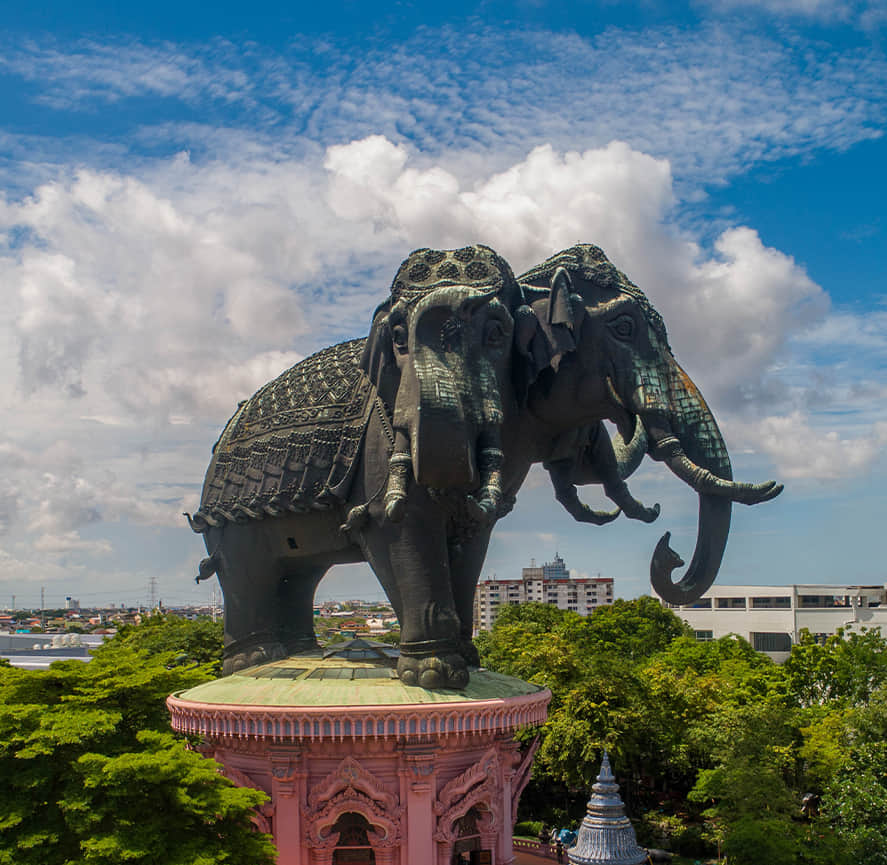
Erawan Museum opening hours through the week.

Happy customers from 70+ countries all around.
Rated across Trip Advisor and Google reviews.
Special curated Indian itineraries built for Indians.
Always there to help before and during trips.

It is a matter of fact that in Buddhism, Lord Indra is considered to be the leader of heaven as that of Hindu Mythology. Indra is believed to be the leader of all gods. The Thai word Erawan translates to water, rain cloud, rainbow or lightning and all these signifies Indra using the Erawan Elephant as his vehicle to fly across the realm to give rain to the earth. As per the legends, Lord Shiva gave Indra the vehicle of a three headed elephant and some say it is the child god living in the realm of heaven. When Lord Indra wishes to travel, the child god will transform into a white elephant. As per the Vishnubrana Book, Erawan Elephant happens to be the magical creature that was present during the uproar of the seas.
When you explore the mysteries of the underworld, you will come across a human earth section that represents Mount Meru which is considered to be the centre of the Buddhist universe. This towering structure is a technicolored hall that is rich in artistic exuberance and iconography. You will find the place ornamented starting from the walls to the staircase. You will get to witness some of the hand beaten copperworks, intricate stucco by Petchaburi craftsmen, mural paintings, and tin embossed tableau. The roof of the structure represents the world, milky way, and the zodiac finished with a splendid stained glass ceiling.

The Three Headed elephant structure is considered to be the iconic representation of the Erawan Museum. The statute is about 29 meters high, 39 meters long, and weighs more than 250 tons. The statue of Airavata which is Erawan in Thai, is considered to be the mythological vehicle of Indra as well as the symbol of the eastern religion’s cosmography. While taking a tour of the museum, you must spend time exploring the structure to know more about the intricate designs as well as work of art.
Planning A Trip To Thailand, Checkout Our Thailand Honeymoon Packages Now!

You will come across a number of Buddha sculptures all across the museum. The statue of the Bodhisattva Guan Yin stands tall in the middle of the heaven level of the museum and 4 supporting pillars that depict the religious scenes. You will also come across a number of Buddha images in 8 different postures. In the belly of the beast, Tavatimsa Heaven, you will get to see the sacred beings congregating. There are a series of Buddha images in various postures and while walking that are fashioned in the concave walls. The total complex has got fusion of arts, ideas, and religious accents in solemn serenity.
Recommended Read: Bangkok Tour Package

Once you are done with the exploration tour of the Erawan Museum, you can come over to marvel at the beautiful gardens at Erawan museum in Bangkok. The gardens are popular for their surrealistic displays of the lush tropical plants. You will find specially constructed stone paths to walk around embracing the beauty of the gardens. You will also get a chance to feed the schools of carp in the rock ponds and marvel at a number of mythological statues on your way. The garden is home to some of the rare plants that are scattered all over the garden area giving you a chance to capture some of the best photos.
Check This Out: Things To Do In Thailand
I. Suvarnabhumi floor: Suvarnabhumi Floor happens to be the basement of the elephant building that showcases a wide range of antiques and ceramics of the bygone era. This floor of the museum conveys the importance of the cultural travel of the people residing in Southeast Asia. Pottery making has been considered as an innovation in the production of utensils and it appears to have been used for thousands of years in the Suvarnabhumi territory. Apart from pottery, you will also come across a number of other antiques displayed in the floor that takes you back in the timeline to the old days of Southeast Asia. You will come across many idols in the ancient Khmer Art and furniture of the Siamese craftsmen in the Rattanakosin Period.
II. Human world: Human World is a circular building that supports the weight of the elephant. The work of art on this floor having influence of east and west is blended perfectly with the brick masonry holding light pink colored mortar. You will find one of the largest world maps on the ceiling of this floor that is decorated with stained glass. The world map is a work of Mr. Jacob Schwarkopt, a German artist, who used only 4 colors to signify the four elements namely - Earth, Air, Fire, and Water. Earth is denoted by yellow color, fire is denoted by red color, wind is denoted by white color, and water is denoted by blue color. Apart from the world map, you will also find a zodiac painting and a picture of human life in the world that conveys the influence of stars on human life.
III. Cosmic layer: The Cosmic layer is the universe floor inside the elephant shaped building. The path to the floor is white and pink crafted in the shape of a circle around the Phra Ket Arch. In order to reach this floor, you can either take the elevator located in the left hind leg of the elephant or a spiral staircase which is located in the right hind leg of the elephant. The walls besides the stairs are very well decorated with a wide range of murals that depict stories of mythology and fairies. You will come across a beautiful painting of the cosmic solar by german artist on the ceiling of the cosmic floor. The picture has the sun, eight planets, the milky galaxy, and some meteorites. In this artistic representation, you will come to know that certain things co-exist in nature and humans are nothing more than just a tiny speck of dust.
IV. Pilgrimage route: Erawan Museum has many places of worship near it and it organizes a pilgrimage route for the visitors so that they can pay respects and get blessings at the pagoda. Some places of worship situated within the pilgrimage route of the museum include Phra Ket Chulamanee Chedi, Ganesha Shrine, Sala Phra Brahma, Trimurti Buddha Hall, Isawapong’s elephant family, Witsanupong family elephants, Indra on the Erawan elephant, the Prompong family elephant, Bodhisattva Avalokitesvara (Guanyin) in the blessing giving posture, and the Class of the Universe. These places have various idols of gods and goddesses with numerous pilgrims coming to get blessings for prosperity from these spiritual anchors.
The Erawan Museum is located near the Pu Chao BTS Station and Chang Erawan BTS Station. From there you can go to the BTS Pak Nam Station and you will reach the Phra Buddha Chinnarat Mongkonprakan vihara. The other station near the museum that will take you to some pilgrimage sites is BTS Kheha, where you can visit the Ancient City, Thamma Katanyu Foundation Shrine, and Wat Asokaram. You can take a bus from various stations to the rest of the worship places around or you can just book a cab from your hotel or wherever you are staying and explore the pilgrim sites along with the city views.
Also Read: Places To Visit In Bangkok
From 19 verified visits
This was perfect. Saved 1400Rs than original ticket price at the counter. Loved the experience. It was easy to purchase the ticket while we were at the monument. Everything was done within 30 minutes.
The prices in thrillophilia were very affordable compared to many other , confirmations are quick and didn’t have any issues with ticket entry was smooth I would 100% recommend you to book the tickets here.
Quick links to everything else worth a slot on a longer stay.

.jpg?w=1536&q=65&format=auto)
%20(1).jpg?w=1536&q=65&format=auto)