7:00 AM - 5:00 PM every day.
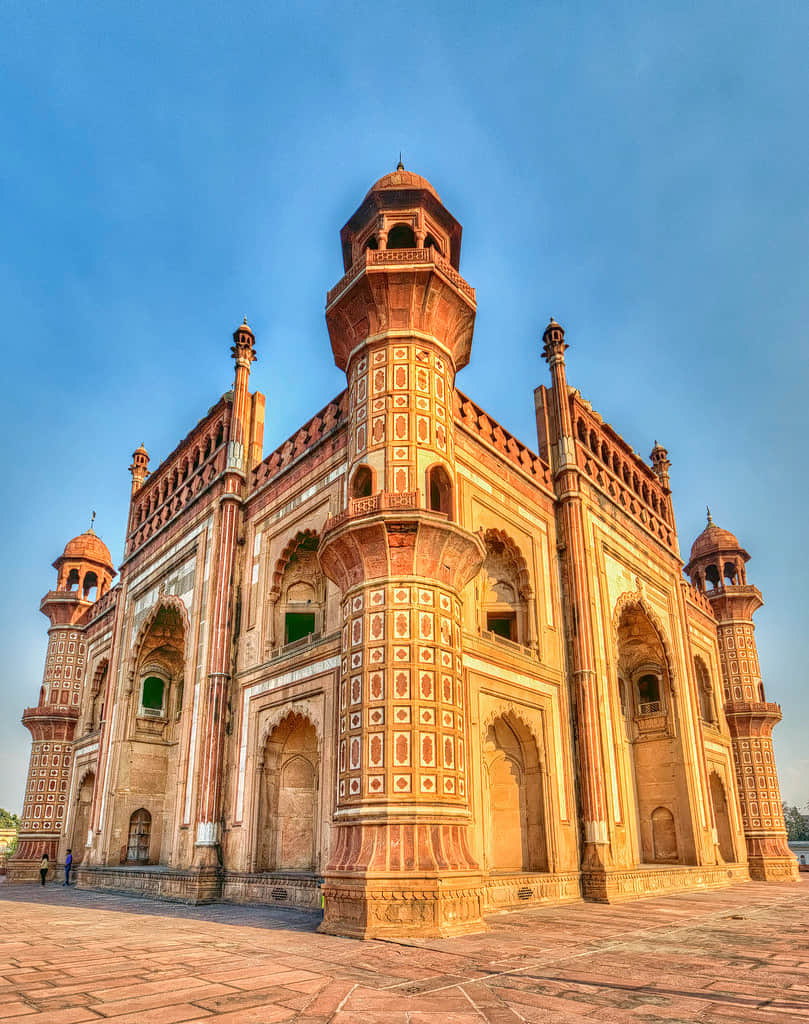
Safdarjung Ka Maqbara popularly known as Safdarjung's Tomb was built in 1754 by the ruler of the Mughal empire of the time, Ahmad Shah Bahadur. The ruler devoted the constructed of the tomb to the prime minister of his court, formally known as Wazir ul-Hindustan, Safdarjung.
The garden tomb also holds a mausoleum that was built by the son of Safdarjung, Ahmad Shah Bahadur and the mausoleum is said to have been one of the last construction by Mugal's as they soon began to fall from their power.
Safdarjung himself was a Persian who came to India in 1722 AD. In 1739, he was able to become the surbahar of Oudh and a key member of the state. Soon he moved to Delhi where he was made 'Minister of Hindustan' and served as the same for a short span of 4 years between 1750 and 1754 and passed away in the same year.
It was then when his son pleaded to the emperor for a mausoleum to be constructed and devoted to his father. It was soon granted and thus the mausoleum was brought together. The place holds a high significance in the history of India and the Mughal Empire as it's the last giant garden tomb made during the Mughal empire.
The Architecture of Safdarjung's Tomb
The Safdarjung's tomb was made in parallel with the greatest tomb of Humanyu's. The tomb is surrounded by an enormous courtyard garden running for 280 meters per side. Apart from the garden the enormous garden tomb also holds a mosque with three domes.
The entire building is carved out of yellow/brown colored sandstone and uses various pieces from another mausoleum of Abdul Rahim Khankhana. The entrance to the tomb is massive and a view from here vividly captures the entire structure. Furthermore, there are also a number of rooms one of which is a library, managed by the Archeological Survey Department.
The tomb also holds a number of inscriptions and carvings written in the Arabic language which has been translated by many historians. A variety of chhatris, chambers, and kiosks shaped in rectangular, polygonal and octagonal shapes reside inside the tomb which makes the structure breathtaking.
The tomb also has an underground chamber where the graves of Safdarjung and his wife lies. The garden area is also a spitting image of a number of Mugal style constructions throughout the country. The water canals that rest inside the tomb work their way through the garden into various regions of the tomb including 'Jangli Mahal' and 'Badshah Pasand' among others. All in all, the architect of Safdarjung's tomb is well crafted and magnificently executed.
Facts about Safdarjung's Tomb
The Safdarjung's Tomb is encapsulated with a number of interesting facts that make the place even more enigmatic.
1. The Safdarjung's Tomb was constructed in 1754 during the reign of the Mughal emperor, Ahmad Shah Bahadur.
2. The mausoleum was built by Safdaejung's Son, after his death. Safdarjung was titled as 'Prime ministers of Hindustan' and served his position as the same from the year 1750 to 1754.
3. The mausoleum is said to be one of the final constructions by the Mugal Empire as soon as the descent of the empire began.
4. The entire structure is constructed out of brown and yellow sandstone and marble.
5. The tomb carries the essence of Safdarjung and his wife in an underground chamber.
6. The entire garden tomb is spread across in a square format with more than 280 meters of land each side.
7. A large amount of the materials used including the marbles were taken from the Abdur Rahim Khan-I-Khana's tomb during the construction.
8. The enormous garden is divided into 4 squares. These are again subdivided into other squares in a pattern called Char Bagh.
Tips For Visiting Safdarjung's Tomb
There is some essential information one should know before visiting Safdarjung.
1. The entity to the place is not free and the charges vary from INR 5 - 100 depending on Indian or Foreign nationality.
2. The garden tomb is large and exploring the place might take some time. Make sure you visit well in advance.
3. A good time to visit is early in the morning when the place opens.
4. Shooting video of the place is allowed but will require visitors to pay extra. Up to INR 25.
5. Don't forget to carry a bottle of water. The exploration can be taxing and it is important that you are hydrated.