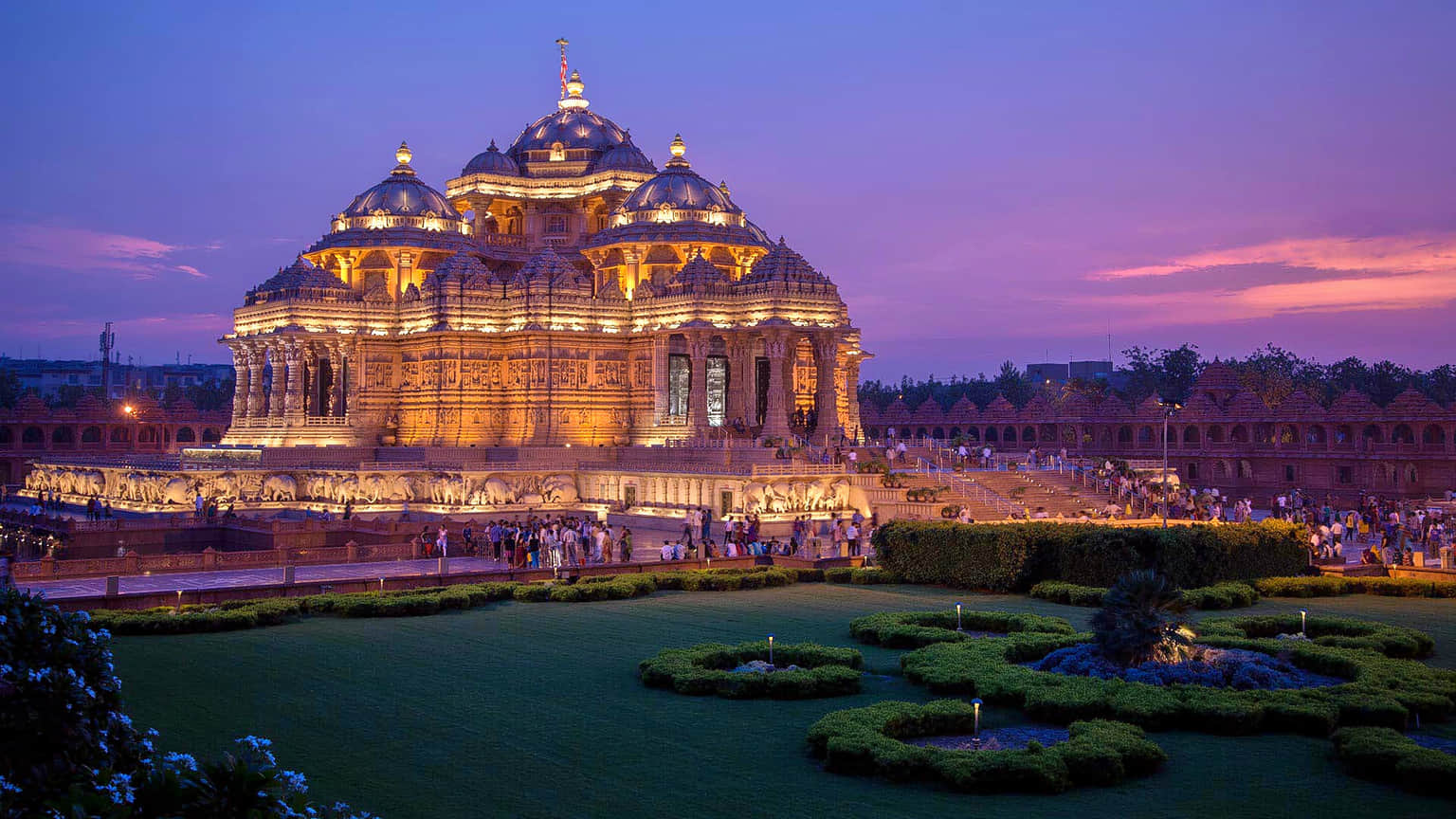
A place of eternal holy communion, Akshardham is a temple complex located in the capital city of India, Delhi. The godly establishment is highly recognized for its mesmerizing architectural design, divine prayers and devotion and a locale where tourists from all around the county visit to participate in a number of festivities and events that transpire throughout the year.
The temple is dedicated to Bhagwan Swaminarayan and various embodiments of Hinduism who have a great impact on the Hindu religion. Built-in the year 2005, the Akshardham temple homes more than 200 idols of a number of gods and avatars.
Created completely in sandstone and marble, the entire construction of the temple took more than 8,000 workers and 300,000,000 hours. A visit to the temple allows visitors to embark on a spiritually rich journey dictating ancient Hindu techniques of achieving eternal peace and serenity.
Apart from prayers, tourists can also partake in various exhibitions on Hinduism that also preach the learnings of Bhagwan Swaminarayan's on non-violence acts, prayers and more. Water shows are also a recurring event that happens in the temple premises and it is one of the top crowd pullers.
There is also the Abhishek Mandap where visitors can participate in a series of spiritual events. From narrating a holy Sanskrit Shlok to bathing the Neelkanth Varni idol, the entire mandapa provides a more sacred and religious experience to the tourists.
In short, the Akshardham complex is a place of complete serenity, holiness and a calm atmosphere where visitors are encouraged to pray and participate in a variety of spiritual events.
The architecture of Akshardham:

- Garbhagriha - Found right in the epicenter of the Akshardham complex, the Garbhagriha holds a giant Bhagwan Swaminarayan idol. Leading to the idol there are several other murtis of Hindu connoisseurs designed in a variety of poses illustrating eternal devotion to Bhagwan Swaminarayan.
These murtis of the followers include Shastriji Maharaj, Yogiji Maharaj Gunatitanand Swami, Bhagatji Maharaj, and Pramukh Swami Maharaj. Looking around the architecture visitors will also find a number of tombs of gods and devotees including pairs of Shri, Radha-Krishna, Shri Lakshmi-Narayan, Sita-Ram, and Shri Shiv-Parvati. At Garbhagriha daily prayers are also conducted. Visitors can partake in these aarti between 10:00 AM and 6:00 PM.
- Mandovi - Standing at a staggering 25 feet in height and 611 meters in length, the entire Akshardham complex is one of the greatest temples to be built in more than 8 centuries. The temples hold a Guinness book record for the same as well.
The distinct architecture of Mandovar, especially it's roof, entices visitors to lean into a life filled with peace and spirituality. The Mandovi also encompasses close to 230 pillars with a vast exhibit of inscriptions and carvings.
In the middle of the Mandovi, also known as Vibhuti, lies a number of sculptures and idols of avatars, gods, devas, acharyas, and devotees. Furthermore, the floor of Mandovar is embedded with a number of animals and other living beings.
- Gajendra Peeth - At the lower pradakshina, Gajendra Peeth is a hymn to the elephants. It's architecture also depicts an ancient tradition that involves the Mayamtam, Shilpa Ratnakar and Diparnav among other carvings and sculptures of elephants.
The tradition has been very commonly used in the construction of mandirs and other holy establishments from the beginning of the 12 century. The series of elephant's structure at Gajendra Peeth also depict a variety of stories some describing the relationship of humans with elephants with others narrating stories of the Panchatantra.
All in all, the place holds more than 148 elephants weighing more than 3,000 tons.
- Narayan Peth - The Narayan Peth consists of 3 gigantic bronze relief panels, racing up to 60 feet, that depict a series of incidents from Bhagwan Swaminarayan. These include inviting the visitors to keep God above all and describe them the significance of maintaining faith in the divine God.
Narayan Peth is also an ancient sign of respect and humility while conducting pradakshinas. Devotees can take a walk around the panels depicting that God should be in the middle of it all.